Links
The development of Topographica was supported in part by the U.S. National Institutes of Mental Health under Human Brain Project grant 1R01-MH66991, and by the U.S. National Science Foundation under grant IIS-9811478.
Educational applications of Topographica are supported in part by the University of Edinburgh Doctoral Training Centre in Neuroinformatics, with funding from the Engineering and Physical Sciences Research Council and the Medical Research council through the Life Sciences Interface. For sample assignments see the web page for the course Computational Neuroscience of Vision (CNV) offered by the School of Informatics of the University of Edinburgh.
If you use this software in work leading to an academic publication, please cite this reference:
James A. Bednar. Topographica: Building and Analyzing Map-Level Simulations from Python, C/C++, MATLAB, NEST, or NEURON Components. Frontiers in Neuroinformatics, 3:8, 2009.
or in BibTeX format:
@Article{bednar:fin09,
  author  = "James A. Bednar",
  title   = "{Topographica}: {B}uilding and Analyzing Map-Level
             Simulations from {Python}, {C/C++}, {MATLAB}, {NEST},
             or {NEURON} Components",
  journal = "Frontiers in Neuroinformatics",
  year    = 2009,
  volume  = 3,
  pages   = 8,
  url     = "http://dx.doi.org/10.3389/neuro.11.008.2009",
}
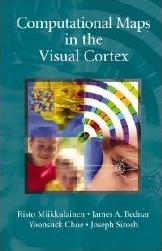
Many of the ideas in Topographica were first developed in conjunction with our book:
Risto Miikkulainen, James A. Bednar, Yoonsuck Choe, and Joseph Sirosh. Computational Maps in the Visual Cortex. Springer, Berlin, 2005.
The book has background on cortical maps in general, descriptions of the various levels of modeling, and a detailed presentation of the scaling equations that underlie Sheet coordinates (which are also described in Bednar et al. Neuroinformatics, 2:275-302, 2004).
Other useful simulators:
Detailed low-level modeling of neurons and small networks. It is possible to use these simulators for topographic maps, but the computational requirements are usually extremely high, and typical users simulate much smaller networks. Note that there are now (3/2007) Python bindings for Neuron, so it should be practical to wrap a Neuron simulation into a Topographica Sheet for analysis.
Brian is a pure Python simulator (like Topographica) that supports spiking models using a very clear differential-equation-based specification style. It’s targeted more at networks of neurons than at organized maps, but can also be useful for maps.
NEST (formerly called BLISS) is a general-purpose simulator for large networks of neurons, but without an explicit focus on topography. Much of NEST is based on a custom stack-based scripting language (like RPN calculators or PostScript) that is not nearly as friendly as Python, and requires much more of the simulation code to be written in C. On the other hand, NEST does provide many useful, high-performance primitives, has good parallel computer support, and can be particularly useful for models that do not fit Topographica’s abstractions closely. NEST now offers a Python interface, which can be used to wrap a spiking NEST simulation as a Topographica sheet. See Bednar, Frontiers in Neuroinformatics 2009 for an example of such an interface.
The NCS simulator focuses on large-scale simulation of networks of spiking neurons, using C/C++ with a custom specification language rather than an extensible scripting language. Thus it is likely to be useful primarily for running simulations very similar to those built by the developers, rather than being fully extensible as Topographica is.
iLab Neuromorphic Vision Toolkit is a high-performance computer-vision oriented C++ toolkit from Koch and Itti with support for saliency maps for modeling attention. It has a strong focus on topographically organized regions, but at a high level of abstraction, and without specific support for learning and development. As for NCS, it also requires more time-consuming and less flexible development in C++.
Formerly called PDP++, Emergent focuses on simulating neural networks of various types, for either engineering or cognitive science applications. Although there is support for networks arranged as maps (e.g. Kohonen SOMs), the interface is designed to make the influence of individual units clear, which is not typically useful for analyzing maps. In any case, Emergent has less emphasis on simulating biological experiments and brain tissue than does Topographica, instead concentrating on more abstract systems that perform specific tasks.
Simple, basic artificial neural-network simulator (primarily abstract backpropagation networks, but also has support for Kohonen SOM models of topographic maps).
Highly graphical Java-based simulator covering numerous levels, from ion channels to behavioral experiments. Can be used for some of the same types of models supported by Topographica, but does not have an explicit focus on topographically organized areas. May not currently be maintained.
Other potentially useful simulators are listed at the Emergent site.